
CONSPIRACY!
Are there more conspiracies than ever? Are we dumber than ever?

I have been thinking a lot about conspiracy theories in our modern world, but not the BIG ONES, but the little dumb ones. Like:
The Stranger Things finale was so bad, many fans thought it was a ruse for a SECRET ENDING
That Katy Perry might actually be Jon Benet Ramsey
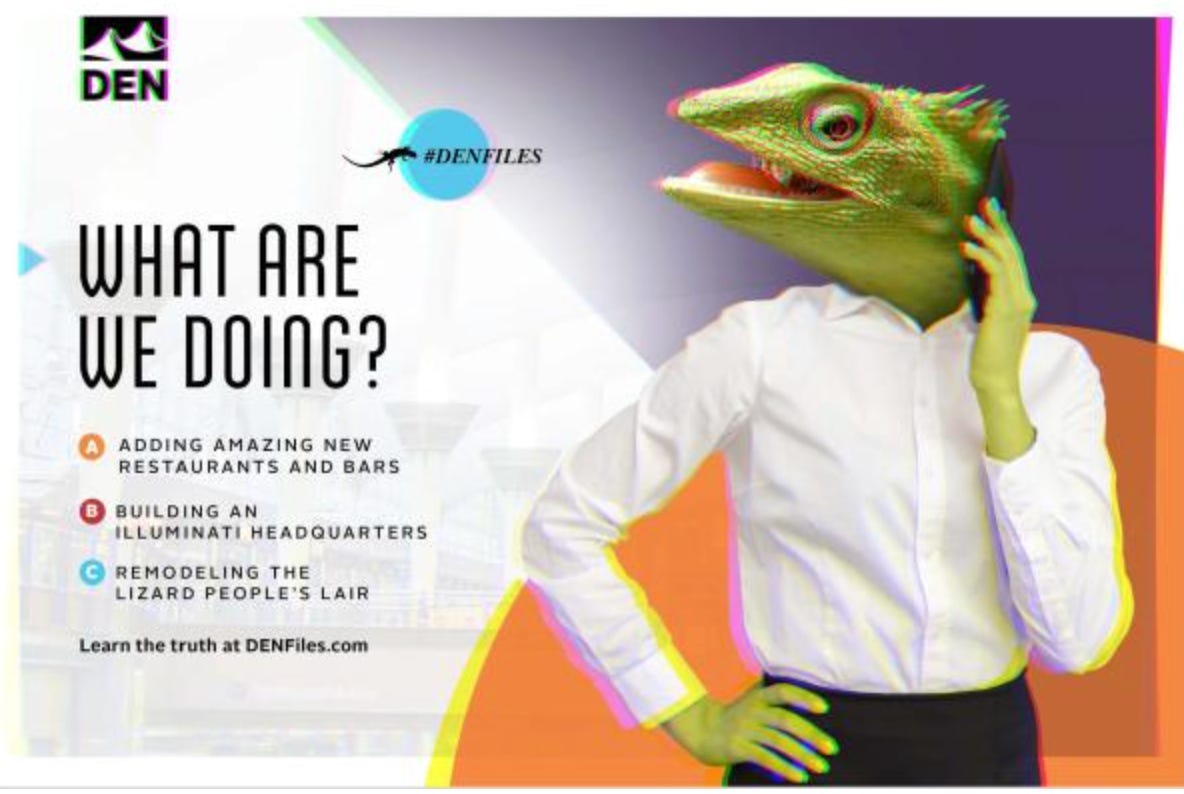
That the Denver Airport is actually an Illuminati / Free Masons / Underground Bunker Filled with Doppelgängers. They even have a little fun with it every once in a while!
I’m less concerned in what conspiracies you believe — but I’m more concerned with are there more conspiracies now than ever? And does that mean we are stupider now than we were 100 years ago?
Question 1: Are there more conspiracy theories now?
Boy, it sure feels like it — every day it seems like there is a new conspiracy and it looks like they are in more areas than ever (i.e. not just politics!).
After the AFC Championship in 2024, many people believed that the Chiefs would win the Super Bowl and it would lead to Taylor Swift and Travis Kelce (another focus of conspiracy theories) to endorse then-candidate Joe Biden for president.
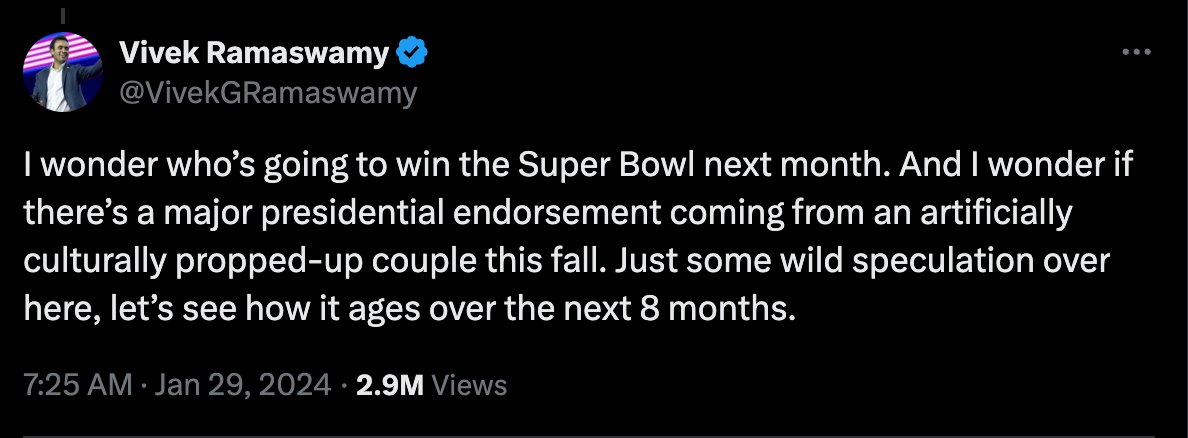
Avid reader, you may remember that Chiefs did not win AND also Joe Biden didn’t end up as the candidate (though Taylor Swift did endorse Kamala Harris in September of that year).
The idea of “industry plants” who are music artists manufactured for public consumption, such as The Kid Laroi. He went from high school star to “global icon” in two years due to his relationship with the late rapper Juice WRLD. Do all of these sound like fake people to you? If so, would it surprise you that people think the music industry is trying to manipulate you to like them?
In sports, a recent insane one said that - the Dallas Mavericks traded away once-in-a-lifetime talent, Luka Doncic, to the Lakers so they could purposely tank the value of the team so that it would be easier to move the team to Las Vegas. Owned by the casino magnates, the Adelsons, the conspiracy theory makes sense — they can’t legally gamble in Texas! Las Vegas is where they are from! It’s been repeated on a very popular sports podcast. The following year, the Dallas Mavericks got the number 1 pick in the draft and presumptive rookie of the year candidate, Cooper Flagg — as of writing this week, they have reaffirmed plans to stay in Dallas.
Are we stupider now? Why are we being fooled across every vector?
Well it turns out we are seeing more conspiracies than ever, some data on teens exposure to conspiracy:
A 2024 News Literacy Project survey reported that 81% of teens believe at least one conspiracy theory, and half see conspiracy theories online at least once a week
BBC’s 2025 teen survey found 51% of teens said they had seen conspiracy theories online, while 18% were unsure
The train is out of the station — but can we find a pattern where conspiracy emerges? Can we detect how they emerge?
Question 2: Is there a pattern for Conspiracies?
Yes, but it’s changed a lot — let’s look at everyone’s favorite spot for conspiracies — politics! I was piqued to write this article, based on this data from the Pew Trust Index on how many people trusted government:
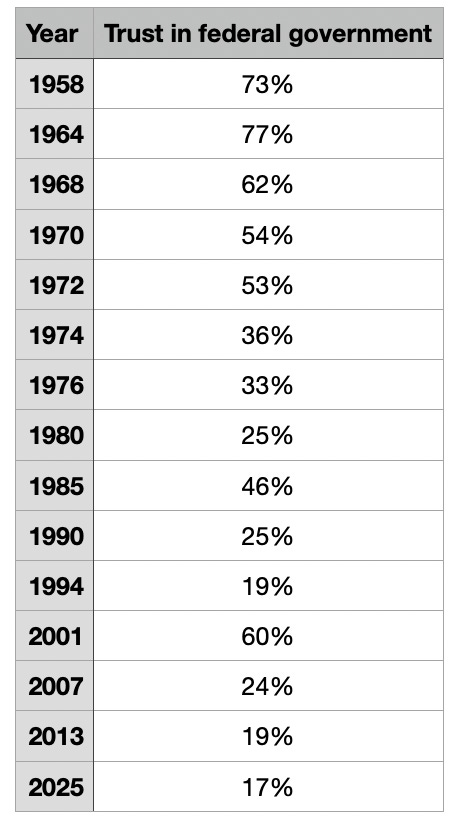
With the exception of 2001 — it’s very bad! It’s the worst it’s ever been! It’s a pretty reasonable straight line to draw, when we don’t believe in our institutions — we get more conspiratorial…we are searching for something to ground us and we will grasp at whatever straws are there to make sense of things. But it’s only part of the story, each good (??) conspiratorial time had a few congruent factors:
A trigger | This is usually a cultural shock (think wartime or economic) that forces people to ask for meaning
A doubling-down in the wrong direction | We want good-faith actors, but when the people we trust start leading us down the wrong paths, we start to SUSPECT something is afoul
A great medium for distributing information | This distribution gets a lot of people on board quickly and this is accelerating
Let’s look at two political examples:
In 1964–1974, trust fell in HALF due to the onset of the Vietnam War, but as the government continued to double-down in the wrong direction (Pentagon Papers and Watergate) — the situation was ripe for a conspiracy theory to step in. Namely when Bill Kaysing emerged.
Bill Kaysing was an American writer and former technical writer for Rocketdyne, a NASA contractor, who originated the moon landing conspiracy movement. In his 1976 book, We Never Went to the Moon: America's Thirty Billion Dollar Swindle, he argued that NASA faked the Apollo missions on a Hollywood set due to technological inadequacies and to distract from social issues.
(Ed. note: A great deal of his work today is used to underpin a number of the Flat Earth theories today, to which his own children say: “If you think the Earth is flat, then I don’t consider you a serious researcher. I think you are a kindergarten dropout. Serious hoax researchers, they base their evidence on scientific and photographic anomalies and go where the evidence takes them. Flat-Earthers preemptively deny space travel in general because any photos of the Earth from space contradict their religion.”
By the end of 1976, 28% of Americans believed that we did not land on the moon; by 2022, that number had fallen to 10%.
In the 1980s we had climbed back in some government trust, but then it was quickly eroded again in the last half of the 1980s. Again, the trigger here was Cold War tensions (we can argue if this is a real war or not), with a doubling down in Reaganomics and Iran-Contra [Ed. note and <hand waves at the Reagan administration>]. But a new panic emerged, this time not spread by books, but rather by television.
The Satanic Panic — a moral panic that emerged in the United States during the 1980s, marked by widespread allegations of Satanic ritual abuse, particularly involving children in daycare settings — became widespread by a single book titled Michelle Remembers, which was published in 1980.
The book focused on the therapy sessions between Dr. Lawrence Padzer and his soon-to-be wife Michelle Smith. they recount a number of satanic ritualized abuse that happened to her when Michelle was younger (Ed note: most of this book was debunked, in fact: After the book’s publication, Pazder withdrew his assertion that it was the Church of Satan that had abused Smith when the Church of Satan threatened to sue for libel).
But the book was printed in 1980, but the real panic didn’t hit until the late 1990s — when Oprah and Geraldo Rivera covered the RISE OF SATANISM within months of each other. Geraldo’s two-hour special was watched in 19.8 MILLION AMERICAN HOMES. To give you an idea, that’s as many people who watch evening coverage of the Olympics this year. And how many people believed it? Well, everyone:
A report cited by De Gruyter (drawing on Ross 1994) indicated that by 1991, roughly 70 percent of Americans believed in the existence of sexually abusive Satanic cults. A 1994 Redbook magazine survey similarly found that 70 percent of Americans believed that Satanic ritual abuse was real.
We’ve been fooled before, we’ll get fooled again, and our minds are ripe for it. Triggers are everywhere: global war, shaky economy, AI, etc. — it seems as though every leader we have insists on making them worse. (Example 1, Example 2, …. Example 100…).
Question 3: Why am I getting conspiracy theories about Stranger Things?
I think this is the core point of my thesis — it’s not surprising to me that politicians are easy targets for conspiracy theories — it is surprising to me that it’s spilling into new verticals (sports, music, pop culture).
But I think two new things have been added to the equation of Trigger + Continued Double-Down + Distribution + Bot Speed + Reinforcement.
Our current time has two factors:
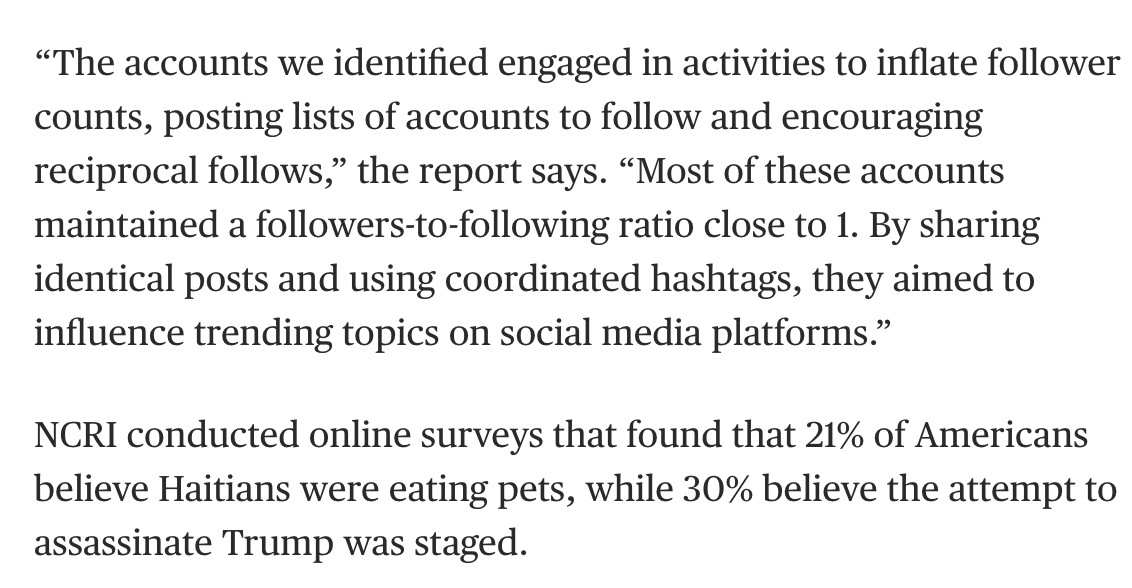
High Speed Bot-Driven Distribution — This is both the factors of social media (duh!) but also the factor that bots are amplifying everything — over 40% of traffic around the Cracker Barrel “controversy” was driven by bots. And political conspiracies (on both sides of the aisle) — were using bot traffic to amplify conspiracies (#BlueCrew used bots to manufacture conspiracies about the Butler, PA shooting of President Trump, the same occurred on the other side of the aisle surrounding Haitian immigrants eating pets). From the article:
Reinforcement - Once people start solving puzzles, they start to see them everywhere and these sort of twist puzzles exist in all forms of media:
A 2025 University of Bath study found that conspiracy memes get higher engagement because they unite online groups and reinforce shared identity, making them “shareable” by design.
A 2026 University of Kansas study found that fans who spot Easter eggs report higher enjoyment, pride, and are more likely to post online or rewatch. Stronger parasocial connections to stories or characters make people more likely to engage in fan behavior, including sharing theories. That creates a pipeline: creators add Easter eggs → fans hunt clues → social media rewards the most elaborate interpretations → conspiratorial takes get the biggest boost.
Now you’re probably saying — that’s just fan behavior! That would never cross-over, let’s take a look at our AFC Championship / Taylor Swift example from above.
Montclair’s 2024 study tracked 272,406 Swift-related #SuperBowl posts in the week after the AFC Championship, more than mentions of the quarterbacks combined. GUDEA’s 2025 analysis of Swift’s The Life of a Showgirl found inauthentic accounts pushing conspiracy claims (Nazi sympathies, etc.) generated real engagement from fans.
But it’s not all Taylor! Thriller/mystery now accounts for ~25% of all adult fiction sales per Nielsen BookScan, up from ~15% in the 1990s. When Thriller / Mystery movies used to make up <1% of films, since 2000 this number has climbed to 5-10%. 42% of Americans have listened to a true crime podcast, 34% listen to them “regularly.”
There was even a Super Bowl ad with Mr. Beast telling you to go on a digital scavenger hunt for Salesforce(??)
We are rewarding solving crimes at each and every turn. It’s a crime solving time paired with a time where conspiracies are accelerating faster than ever.
Question 4: Chat, are we cooked?
I think, sadly, the answer here is yes? I think you likely need to break this chain:
Triggers - Fewer wars? Fewer economic uncertainity?
Doubling-down - I think in the world of polarized politics, you’ll always get someone doubling-down
Distribution - This is where we can impact — let’s have fewer young people on social media. They are, by nature, less discerning and more susceptible to this type of content (young people get most of their news from social media and in the first 35 minutes of their time on TikTok daily, they are provided with misinformation). Many countries are taking the first steps to do this, we should be next. (Ed note: As a note, I see that ID uploading is the only way we have solved this today — that’s also not an amazing idea. But there are a number of biometric companies that can do age verification without ID.)
Bot Traffic — We could stop this, but I think our technology leaders will not behave in ways that benefit users.
Reinforcement - I’ll actually leave you with a great story out of the Wall Street Journal from this week.
As they chatted on Discord, a platform favored by videogamers, Brundage was eager to get more information, but he didn’t want to come off as too serious and shut down the conversation. So every now and then he’d send a funny GIF to lighten the mood.
“It was a bit of just asking over and over again and then like being a bit unserious,” said Brundage.
At one point, he asked for some technical details. He followed up with the cat meme: a six-second clip that showed a hand adjusting a necktie on a fluffy gray cat.
Eventually the leaker hinted there was a new vulnerability on the internet. Brundage, who is 22, would learn it threatened tens of millions of consumers and as much as a quarter of the world’s corporations. As he unraveled the mystery, he impressed veteran researchers with his findings—including federal law enforcement, which took action against the network two weeks ago.
Solving mysteries is great! We should all keep doing it! But be careful when you’re susceptible and be even more careful when it comes from social media.
Related: https://x.com/wired/status/2044005285560291831?s=46
More data on this here! https://fanbehavior.beehiiv.com/p/fandom-psychosis-stranger-things-conformity-gate